
Cationic
01 · Electric charge
Attraction to the damaged fiber
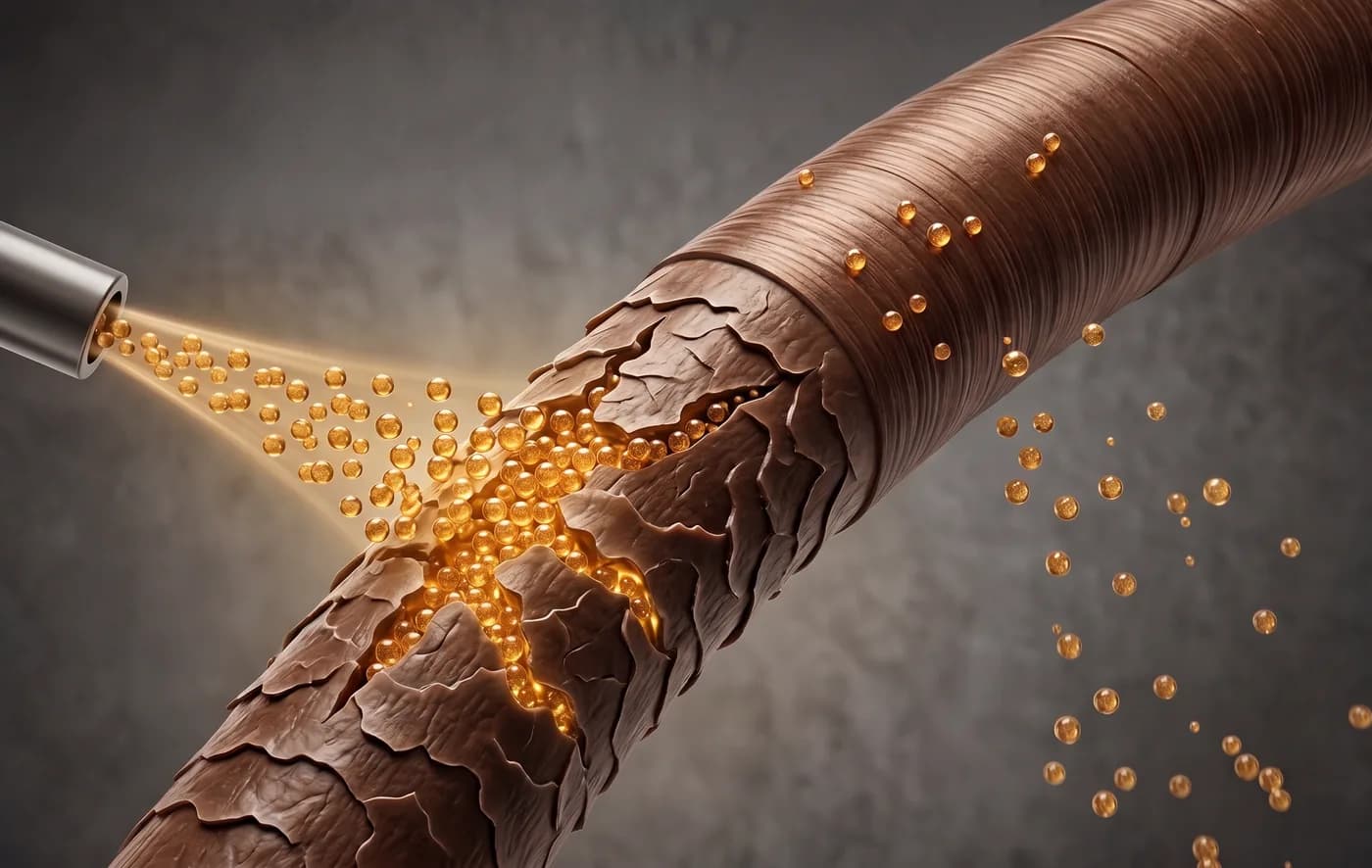
Damaged hair fibers expose negative charges, and the cationic agent is drawn precisely to those areas rather than to healthy hair.
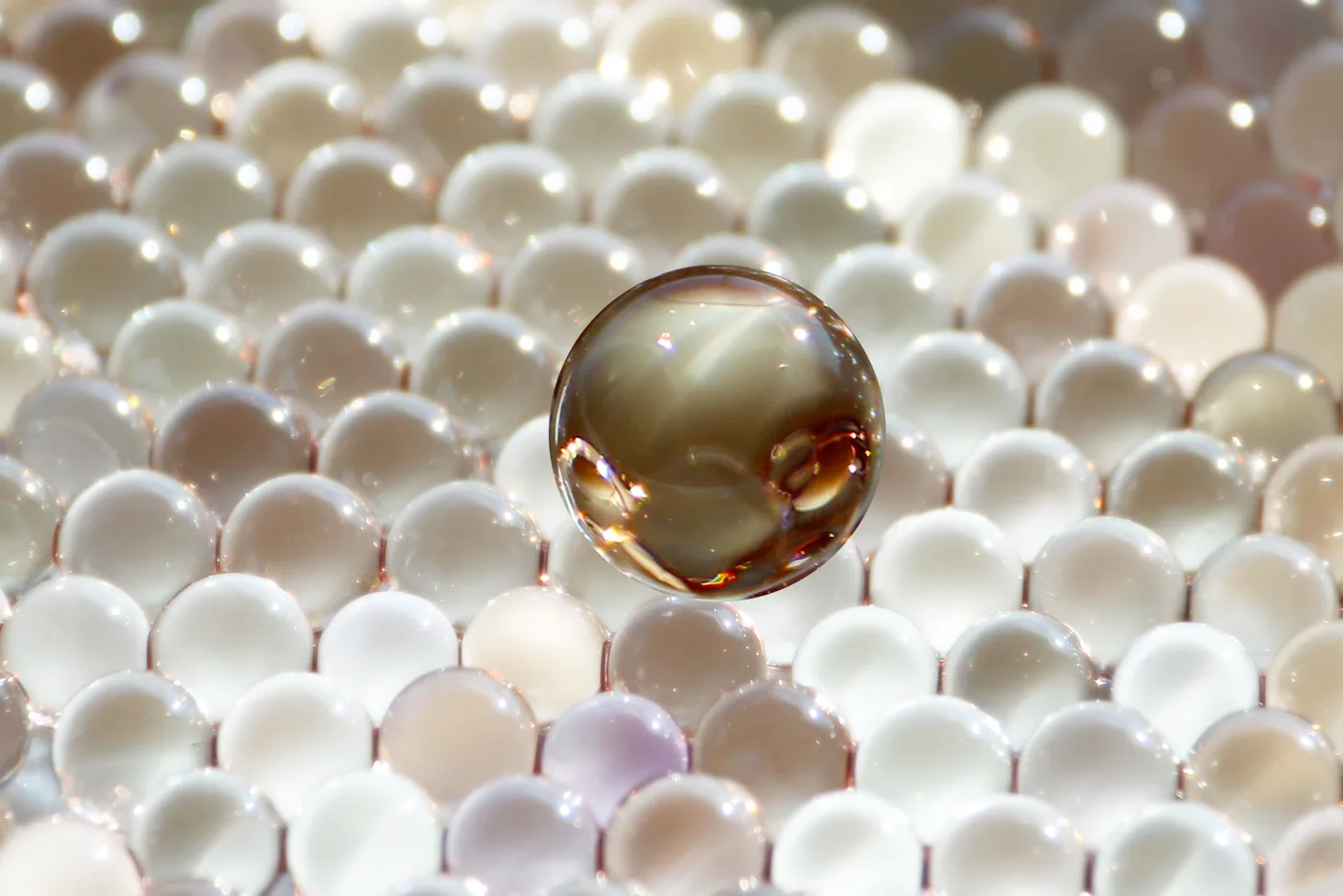
Lipcuat are cationic liposomes: vesicles with a positive charge. Damaged hair fiber carries a negative charge, so the two attract: the active ingredient stops scattering at random and anchors itself where the hair is damaged. The same logic as the liposome, now steered by electrical charge.
Science, in motion
A visual exploration of the electrical affinity between the cationic vehicle and damaged hair fibers.
The problem
The solution
Opposite charges attract, step by step.
Step 01
The liposome is formulated with a bilayer whose surface is positively charged. It carries the active ingredient inside and the electrical affinity outside.
Step 02
When applied, thousands of cationic vesicles come into contact with the fiber. Through diffusion and charge differences, they migrate toward the hair.
Step 03
Heat, color, and friction create negatively charged areas on the damaged cuticle. The cationic vesicles are attracted to and attach themselves to these areas, not to healthy hair.
Step 04
Electrostatic attraction holds the vehicle in place on the fiber. The water drains away, and the active ingredient remains exactly where it's needed.
Step 05
The cuticle scales close over a smooth fiber. That affinity has a technical name: zeta potential. Above roughly +25 mV a cationic vesicle adheres stably, and that threshold is a class-level figure, not the specification of any one reference.
The rinse test
A conventional conditioner coats the entire, healthy hair fiber Part of it is washed away with the water. The cationic vector binds to the damaged areas, which are the most negatively charged, through electrical attraction and remains there even after the water is gone.
It went down the drain
It remains anchored
Why it is different
01 · Electric charge
Damaged hair fibers expose negative charges, and the cationic agent is drawn precisely to those areas rather than to healthy hair.
Why it is different
01 · Electric charge
Damaged hair fibers expose negative charges, and the cationic agent is drawn precisely to those areas rather than to healthy hair.
02 · Vehicle
The lipid bilayer encapsulates and protects the active ingredient from oxidation until it is deposited onto the fiber.
03 · Selective deposition
Instead of being distributed evenly, the supply is concentrated in the areas that need it most, resulting in less waste.
04 · Permanencia
Electrostatic bonding helps the conditioning agent remain on the hair fiber after rinsing, wash after wash.
On the hair
Four areas of hair care where cationic affinity is a game-changer.
It supports the recovery of processed or weakened hair by delivering the active ingredient to the areas where damage is most concentrated
Helps align and seal the cuticle lifted by charge affinity, resulting in smoother, more manageable hair
Designed so that the finish resists fading, maintaining its effectiveness wash after wash
It delivers the active ingredient to the target area with greater affinity and less waste of the active ingredient
Two decades of delivery technology, now applied to hair care.
Years of experience back each formulation.
NanoVec has been refining technologies for more than two decades Delivery and vectorization for global clients in the cosmetics and hair care industries.
At the leading edge of delivery
Cationic delivery technology applied to hair
Affinity by design
Formulations designed to adhere to the fiber
Rigorous characterization
Every vector is documented and monitored
Tailor-Made
Vectors that exist only in your formula
Full traceability
Documentation and traceability for each batch
Global client
Hair cosmetics and advanced care
Lipcuat comes in several variants, and the right one depends on your active ingredient, your pH and your process. Tell us what you are formulating and our technical team will work out which one fits, send you the data sheet or give you a call, before you spend a single hour in the lab.
See the Lipcuat portfolio at NanoVecIts surface carries a positive charge. Since damaged hair fibers carry a negative charge, the two are attracted to each other, and the product selectively binds to the damaged areas.
A conditioner generally coats the hair shaft, and much of it is washed away during rinsing. Lipcuat directs the active ingredient to damaged areas through electrical affinity and helps it remain in the hair after rinsing.
Hair masks, conditioners, leave-in treatments, post-color and repair products, among others. Our technical team evaluates the compatibility of each active ingredient before development.
It depends on the product line and the type of development. For catalog products, the quantities are within the reach of medium-sized laboratories. For Tailor-Made products, this is determined during the technical consultation phase.
Tell us what you're developing. We'll come back with a proposal built on evidence, not a generic PDF.